
Accurately classifying an individual & skin type and tone is crucial for recommending treatments and products that are both suitable and effective. Every person & skin is unique, and a precise assessment enables skincare professionals, aestheticians, and dermatologists to tailor their recommendations to each
client’s needs.
As our population becomes increasingly diverse, and with the advent of advanced AI technology, the industry has started to adopt more nuanced classification systems. These updated methods allow for a more comprehensive understanding of different skin types and tones.
Such classification systems are not only used for product recommendations but are also becoming valuable reference guides. For example, they assist professionals in determining the appropriate intensity settings for laser machines and injectables. This is particularly significant when treating skin of colour,
where careful consideration is essential to ensure both safety and effectiveness. Below are several key ways in which skin classification and tone assessments are used to validate skin type and inform treatment decisions.

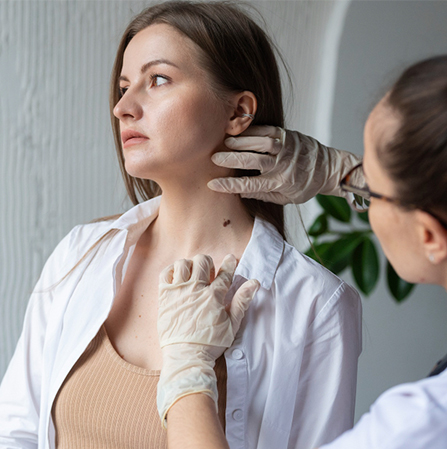
Classifying a patient’s skin type and tone is essential for safe, effective treatment, as it affects responses to lasers, injectables, peels and some skincare products. While the Fitzpatrick Skin Phototype Scale (FST) has been the standard for assessing UV sensitivity and guiding treatment, new technologies and an increasingly diverse populations have prompted dermatology and skincare professionals to explore more detailed classification methods. The Goldman World Scale, the Eumelanin Index, the Individual Typology Angle (ITA), the Monks AI System as well as AI Imaging (such as our Skin Health Analysis) are advanced classification methods that provide a more nuanced classification system for clinical utility, accuracy and inclusivity.
Book Treatment
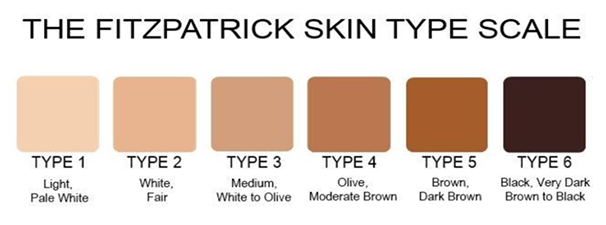
| TYPE I | TYPE II | TYPE III | TYPE IV | TYPE V | TYPE VI | ||
|---|---|---|---|---|---|---|---|
| Highly sun sensitive Always burns Never tans. Fair Skin Fair/Red Hair Possible Freckles Blue/Green colour eyes | Very sun sensitive Burns easily Rarely tans Fair skin Fair/Red hair Possible freckles Light colour eyes | Sun Sensitive May burn Tans slowly Light brown/brown skin Possible freckles Light brown/brown hair Brown/light colour eyes | Minimal sun sensitivity Burns minimally Tans easily Medium/Dark pigment Light & Dark Brown Skin Brown/Dark eye colour | Sun tolerant Rarely burns Tans well Well Pigmented Brown & Black skin | Sun tolerant Never burns Tans well Deeply pigmented Dark brown/black skin Dark brown/black hair Brown/Dark eye colour | ||
| GROUP 1 | GROUP 2 | GROUP 3 | |||||
| TYPE I & II Sensitive to light Doesn’t tan at all or very slightly Will blister & peel Signs of phot ageing/brown spots/wrinkles Greater risk of skin cancer Celtic/Scandinavian/Northern European |
TYPE III & IV
More tolerant to light May go pink/red then develop a tan Few signs of fine lines & wrinkles/brown spots/larger areas of pigmentation Moderate to skin cancer or sun damage Can peel & blister if too long in the sun Mediterranean/South ern European/Middle Eastern/ Far Eastern/Combination of different races |
TYPE V & VI
More resistant to light Least risk of sun damage or skin cancer Tans easily/ can stay in the sun longer Rarely peel or blister Lines & wrinkles appear very late in life Asian (Mid Asia) or African background Large areas of pigmentation will appear in later life |
|||||
Introduced in 2002 by Dr. William Goldman, incorporates racial ancestry and pigmentation tendencies alongside Fitzpatrick phototype to classify skin into five broad ethnic/racial types. It evaluates both burn/tan likelihood and risk of post-inflammatory hyperpigmentation (PIH), improving predictions for pigmentary reactions across heritage groups. This system guides safer cosmetic procedures by identifying patients with high PIH risk who may need gentler treatments, even if their Fitzpatrick type suggests otherwise. While more inclusive and predictive than Fitzpatrick alone, Goldman’s scale remains partly subjective and may not fully capture intragroup diversity. It serves as a useful tool for treating diverse populations but has not fully replaced the Fitzpatrick scale due to familiarity and added evaluation requirements.
Book Treatment
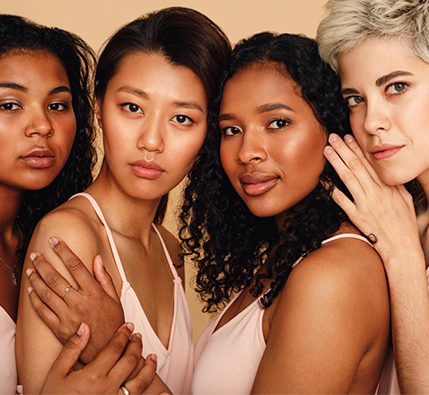
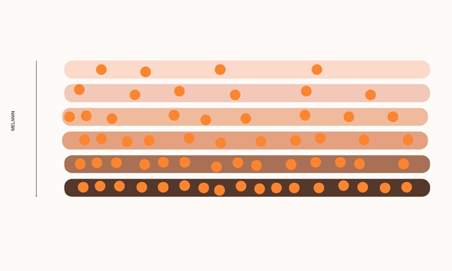
The Eumelanin Index (MI) measures skin pigmentation by assessing how much light is absorbed at certain wavelengths using devices like reflectance spectrophotometers or probes such as the Mexameter. The higher the MI number the more melanin the skin has and provides an objective, continuous measure of melanin in the skin’s surface. MI is commonly used in cosmetic science and dermatology to assess baseline pigmentation and monitor changes, for instance during melasma treatment. In aesthetic clinics, melanin meters guide safe laser settings to helps the aesthetician adjust the lasers energy settings and to minimize burns on darker skin by quantifying melanin content.
Book Treatment
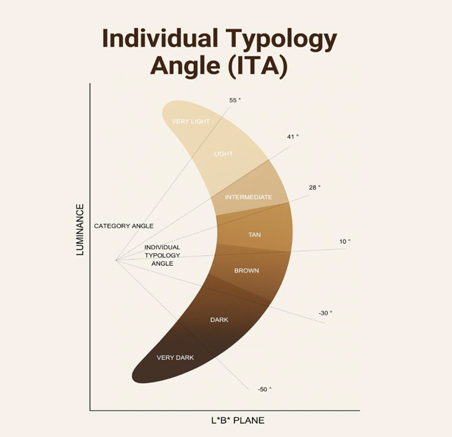
The Individual Typology Angle (ITA), introduced by Chardon et al. in 1991, objectively measures skin colour using CIE Lab values and calculates an angle inversely related to melanin content – the higher the ITA the lighter the skin. ITA categorizes skin into six groups based on specific thresholds, and later studies added a seventh category for very dark tones. Unlike the Fitzpatrick scale, ITA is objective, reproducible, and correlates linearly with skin melanin, making it a reliable research tool for quantifying pigmentation.
ITA assists clinicians in tracking pigmentation changes and tailoring treatments. With numeric precision, it detects subtle shifts in skin colour—useful in procedures like chemical peels or laser selection where patients may have similar phototypes but different ITA values.
ITA devices remove observer bias and is better at differentiating darker skin types as studies confirm its correlation with melanin across ethnicities. However, ITA does NOT assess UV sensitivity or tanning response, for instance, two people with identical ITA can have different sunburn risks. Though ITA overlooks some visual aspects of skin tone, it remains a valuable, objective measure of pigmentation, now gaining ground in clinics as measurement tools become more accessible.
Book Treatment
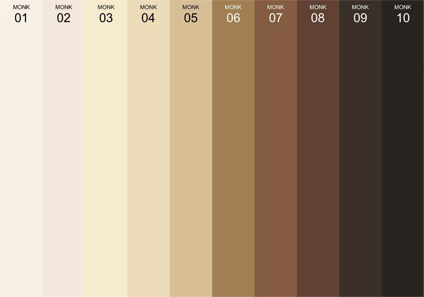
Monk Skin Tone Scale (MST) was developed in 2022by Dr. Ellis Monk and Google and offers 10 skin tone shades with greater gradation for medium and dark tones. His scale differs from models like Fitzpatrick Skin Type Scale as its not based on UV response. Monk uses visual matching, helping technology so that clinicians can more accurately represent and tailor care for people of colour. While originally designed to improve AI fairness in imaging, it’s now used in dermatology to better guide treatments and product choices. Its simplicity and inclusive design make it widely accepted, though it doesn’t address sun sensitivity or skin biology directly.
MST has been well-received as a step toward equity in skin classification, and even consumer products (makeup shade ranges, etc.) have benefitted from its more representative design.
Book Treatment
Advanced imaging devices are increasingly utilised by dermatologists, clinics, and salons to enhance the accuracy and detail of skin assessments. These devices employ multi-spectral imaging techniques, including standard, cross-polarised, and UV light, to thoroughly examine the skin. The imaging data is then processed using sophisticated software powered by artificial intelligence, enabling the evaluation of a wide range of skin parameters such as pigmentation distribution, UV damage, redness, pore size, and wrinkles.
A key feature of these AI Skin Analysis Systems is their ability to generate comprehensive reports that include a “skin type” analysis. This assessment goes beyond the traditional Fitzpatrick scale, offering a holistic profile of the skin’s current condition and its specific needs. By providing practitioners, clinicians, dermatologists, skin care professionals, and beauty therapists with precise data, these systems support more personalised and effective treatment plans for each client.
Book Treatment

AI Skin Analysis System provides more than just a classification; it serves as a diagnostic tool that reveals the extent to which a particular skin type has been affected by sun exposure. Consequently, these advanced systems contribute significantly to the development of tailored interventions and ongoing skin health monitoring.
Our Skin Health Analysis is a state-of-the-art AI Spectral Imaging System, combining RGB, UV, and PL imaging technologies. This innovative system offers a detailed and precise evaluation of your skin. It thoroughly assesses 12 specific skin factors that influence both the dermis and epidermis. By utilising advanced AI imaging and diagnostic technologies, the system delivers a detailed and accurate overview of your skin’s current state, identifying areas that may benefit from targeted attention or improvement. It also provides predictive insights into potential issues that could develop over the next three to five years if preventative steps are not taken.
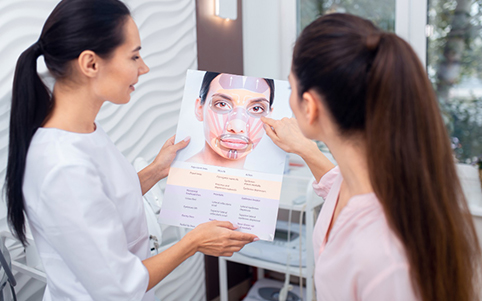
Our Skin Health Analysis is a state-of-the-art AI Spectral Imaging System, combining RGB, UV, and PL imaging technologies. This innovative system offers a detailed and precise evaluation of your skin. It thoroughly assesses 12 specific skin factors that influence both the dermis and epidermis such as:
By utilising advanced AI imaging and diagnostic technologies, the system delivers a detailed and accurate overview of your skin’s current state, identifying areas that may benefit from targeted attention or improvement. It also provides predictive insights into potential issues that could develop over the next three to five years if preventative steps are not taken.
Your Skin Health Analysis results are securely stored. If you opt to purchase the recommended products and follow the customised treatment plan, you will be invited to return for a follow-up Skin Health Analysis after 12 months. This follow-up appointment will allow us to assess your progress and, where necessary, update your treatment plan to ensure your skin achieves the best possible results.
The Skin Health Analysis is designed to equip you with the knowledge required to make confident and effective decisions about your skincare. Precise determination of your unique skin type serves as the cornerstone for all subsequent recommendations whilst ensuring that every piece of advice provided is personalised and support you
Book Treatment
By harnessing predictive capabilities, the Skin Health Analysis System is able to anticipate potential issues that could emerge over the next three to five years should existing concerns remain untreated. This forward-looking approach empowers clients to address problems proactively and minimise future risks.
Based on your individual analysis, the system recommends suitable treatments from our salon’s curated menu. These suggestions are carefully matched to your specific needs, ensuring that each treatment option aligns with your skin’s requirements for optimal results.
Clients receive expert product recommendations from our selected range, chosen to complement and enhance the effects of the proposed treatment plan. Each suggestion is formulated to suit your skin’s unique characteristics, maximising the potential for healthy, radiant skin.
By leveraging scientifically validated AI assessment methods, the Skin Health Analysis not only evaluates the current status of your skin but also anticipates future developments. This empowers you to make informed decisions that protect and restore your skin’s integrity, helping to prevent long-term damage.
Should you choose to purchase the recommended home care products and follow the personalised treatment plan, we invite you to return for a follow-up Skin Health Analysis after 12 months.
This subsequent assessment enables us to review your progress in detail, and in conjunction with your initial results, refine your treatment plan and update product recommendations. This ongoing approach ensures your skin continues to achieve its very best.
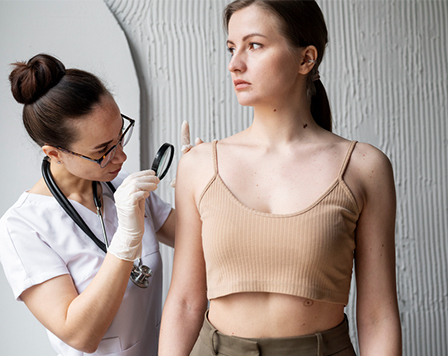
Following the identification of your skin type via the Skin Health Analysis, we will review the analysis results with you. Together, we will discuss your existing skincare routine, the products you currently use, and your personal goals to optimise your skin’s health.
Book Treatment
You will receive detailed, personalised guidance designed to help you optimise your daily skincare routine. This includes instructions on the correct usage of your existing products, recommendations for replacements where necessary, and clear advice on the precise timing and amounts for application. All guidance is tailored to the results of your skin analysis, ensuring maximum benefit for your skin’s specific requirements.
We will identify and discuss the treatments most suitable for your skin type and skincare objectives. Together, we will curate a treatment plan that not only addresses your current concerns but also fits seamlessly into your lifestyle.
Where appropriate, the plan can incorporate aesthetic treatment options, and we can also arrange a consultation with Dr Teresa Day. We will support you and your choices to ensure that every recommendation is aligned with your unique needs and aspirations.
Should you choose to purchase the recommended home care products and follow the bespoke treatment plan, we will encourage you to return for a follow-up Skin Health Analysis after 12 months.
This reassessment provides an opportunity to review your progress in detail. By comparing your latest results with your initial analysis, where applicable, we can refine your treatment plan and update product recommendations.
The Skin Health Consultation is non-refundable . However, as part of your Skin Health Consultation, you are entitled to choose from a selection of advanced facial treatments at an exclusive discount. This allows you to experience a professional treatment tailored to your unique skincare goals, to enhance your skin’s health:
This facial combines cutting-edge hydration and rejuvenation techniques to deliver visibly radiant, revitalized skin.
Utilizing advanced radio frequency technology, this facial is designed to boost collagen, firm the skin, and improve overall complexion.
An innovative 2 Part Facial Treatment that promotes skin renewal & rejuvenation. Please note: This facial is not suitable for clients under 35 years of age.
A professional-grade peel that targets uneven tone, texture, and signs of aging, revealing smoother, brighter skin.


